I have a sister who is currently receiving treatment within a hospital run by a non-profit. I was amazed during my visit with her at the lengths that the hospital staff go to in ensuring that they follow high standards of customer service.
There are many motivational posters through the hospital (even in public corridors) referring to customer service, and also to excellence. In addition, there are also charts that the staff have worked on to develop simple strategies that will help them demonstrate customer service. The nursing and medical staff then follow through using these strategies with their patients.
For example, when the nurse enters a patient's room, their first statement is "Hello Miss/Mr ****, it's (nurse) here. I'm just going to ****. This way, if the patient is resting or not fully alert, the patient at least knows why this person's just walked in. And doesn't awake to a stranger who they don't think should be in the room!
I've mentioned in previous posts that my thinking is that non-profit organisations need to ensure that they are providing great customer service. What this hospital demonstrates is that patients (ie. the hospital's customers) will be willing to choose the services of this hospital over another when required in future. Originally my sister had planned on moving to another hospital, but now is extremely happy to stay and continue to receive excellent care.
Friday, December 11, 2009


Sunday, December 6, 2009
The Link between satisfaction and customer retention
Today I was revisiting some academic readings about customer satisfaction and the effect it has on loyalty. While it is from an academic perspective, it highlights how customers need to be delighted (as opposed to "only" satisfied) to be extremely loyal. The study found that a truly delighted customer will become an evangelist of the business.
This model comes from another book (titled Service Profit Chain: How Leading Companies Link Profit and Growth to Loyalty, Satisfaction and Value), however I've taken it from Lovelock, Patterson and Walker's "Services Marketing: An Asia-Pacific and Australia Perspective" (2007).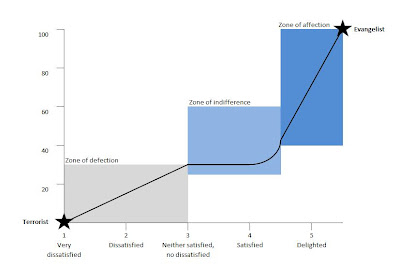 Just to explain my thinking on this model, I'll use the airline industry as an example.
A little while ago we had to fly with one airline in Australia who fell well short of what we expected of an airline. My wife and I have always taken a car seat for our daughter and son to sit on while we're travelling by air, and despite having taken her on around 20 flights, with about 7 airlines in total, one airline refused to permit us to take a car seat on board (even though we'd paid adult fares to be able to reserve seats for both children (our son was six months old at the time, our daughter 2 years). Anyway this airline I wouldn't even rate a 1 out of 5 in terms of their service. The model predicts I would then be a terrorist - in real life I very much discourage anyone from flying with this airline, and even with all the travel that we undertake, we will also never fly this airline again.
We've also flown some other airlines, who while they weren't providing over the top service we at least hospitable, and got us from A to B. These airlines I wouldn't actively promote, but am happy to fly with them were their schedules or pricing works well for us.
Then there are two other airlines that have gone over the top with providing great service. These airlines will always be our preference for flying (Singapore Airlines for international travel, SouthWest for US domestic), and we will always recommend to our friends and family (and now, blog followers!). I would definitely rate both these airlines as a 4.5 or 5 out of 5 in any customer surveys.
While a 4 out of 5 may seem like a good rating for a customer to give (in action, I prefer using a 10 point scale to give customers the option of giving a 9 to allow for "room for improvement" as some customers like to), the reality confirmed by this model is that those customers are just satisfied with the service received (not delighted) and are less loyal and less likely to promote your business.
This model comes from another book (titled Service Profit Chain: How Leading Companies Link Profit and Growth to Loyalty, Satisfaction and Value), however I've taken it from Lovelock, Patterson and Walker's "Services Marketing: An Asia-Pacific and Australia Perspective" (2007).
 Just to explain my thinking on this model, I'll use the airline industry as an example.
A little while ago we had to fly with one airline in Australia who fell well short of what we expected of an airline. My wife and I have always taken a car seat for our daughter and son to sit on while we're travelling by air, and despite having taken her on around 20 flights, with about 7 airlines in total, one airline refused to permit us to take a car seat on board (even though we'd paid adult fares to be able to reserve seats for both children (our son was six months old at the time, our daughter 2 years). Anyway this airline I wouldn't even rate a 1 out of 5 in terms of their service. The model predicts I would then be a terrorist - in real life I very much discourage anyone from flying with this airline, and even with all the travel that we undertake, we will also never fly this airline again.
We've also flown some other airlines, who while they weren't providing over the top service we at least hospitable, and got us from A to B. These airlines I wouldn't actively promote, but am happy to fly with them were their schedules or pricing works well for us.
Then there are two other airlines that have gone over the top with providing great service. These airlines will always be our preference for flying (Singapore Airlines for international travel, SouthWest for US domestic), and we will always recommend to our friends and family (and now, blog followers!). I would definitely rate both these airlines as a 4.5 or 5 out of 5 in any customer surveys.
While a 4 out of 5 may seem like a good rating for a customer to give (in action, I prefer using a 10 point scale to give customers the option of giving a 9 to allow for "room for improvement" as some customers like to), the reality confirmed by this model is that those customers are just satisfied with the service received (not delighted) and are less loyal and less likely to promote your business.
Thursday, November 26, 2009
Great Phone Service
I know that when we look at customer service, it's very easy to take note of poor service and sometimes difficult to recognise good service.
I'm in the process of buying a new car at the moment and amongst a number of companies that weren't replying to emails and phone calls, there was one mechanic that was excellent with their responses. I was just calling to get quotes for some work that may be required, and one business answered promptly and one of their (non-mechanic) staff were able to provide a quote, let me know all the information I needed and suggest a time to book it in. Since everything lined up, it just made sense to book it in and if I buy this car, they've earned $3,000 for a simple phone call. I'm still waiting for return phone calls from other companies...
I also needed to call a technical help desk to reset our TV today. The steps in the manual weren't working, so I was ready to throw the remote at it (my technical skills aren't very high), but I thought that I'd give the customer service line a call. The gentleman on the phone was able to clearly step me through what was required and resolved the issue very promptly.
In many businesses electronic communication is a great asset that can help improve revenues. However, they do also create a higher sense of expectation with the customer as many users will simply assume that if it's electronic communication it should be immediate. Being able to respond promptly to phone calls as in these cases goes a long way to ensuring that you meet the customer's expectations.
Wednesday, November 25, 2009
Grocery Shrink Ray
I was reading The Venture (a blog on The Age website) today about the Grocery Shrink Ray - when companies reduce their product size, but maintain their retail price. While this saves the manufacturer having to increase their prices, it can create a significant consumer backlash.
Along with highlighting some (Australian) cases in which this has occurred, he also offers a list of ten pricing mistakes for small business start ups to avoid.
Along with highlighting some (Australian) cases in which this has occurred, he also offers a list of ten pricing mistakes for small business start ups to avoid.
Tuesday, November 24, 2009
My Job Would Be Easy Without Customers
"My job would be easier without customers."
How many times have you heard your staff or colleagues use that phrase (and many would also add "or staff...")? Generally it is when there are problems in our dealings with a client, or the commercial pressures of trying to gain sales when many staff may feel that "sales" is not their thing.
Over the last few days we've been dealing with a situation kind of in reverse to this. Our hot water service wasn't installed correctly by the builder, however none of the service people in the chain required to fix it are really taking any ownership, so I've had to push our position a little more (5 days of no hot water for baths, showers or doing dishes gets a little draining).
The builder isn't interested since the owners (we are currently renting) have paid their final payment, so the builder isn't responsible for the upkeep. The property manager looking after our house has called the appropriate people, so is following her manuals (but not following up). The manufacturer has subcontracted a plumber to check the hot water system (so the company is saying that they've done what they can). Meanwhile, the plumber contracts for a number of different companies, with many commercial contracts amongst us residential clients, so we're pushed to the bottom of his list.
Any time that I try to complain about having it fixed, each person will simply refer me on to the next person, who then will pass the blame to the next person. It all does a loop back to the builder (and given the state of some of the other aspects of the house, it doesn't surprise me that the builder has cut corners with the hot water system).
Thinking about this today, I realised that form a customer's perspective some times it would be easier to deal with organisations if the organisation's didn't have staff.
While many staff do a good job, the customer will often get different information by asking different staff members. Also, when there's an issue, it usually only gets fixed when the customer is left to arrange for it to be fixed themselves. Everyone just assumes that the person who needs to fix a problem knows about the problem, and that the problem will just magically disappear.
Unfortunately, this doesn't happen. I won't get started on the "but that's not my job" line today (I'm already worked up enough!), but if everyone in the organisation simply helped resolve the issues that the customer in front of you (or on the phone etc), then our customer's would be much happier. In this way, they'd be receiving Platinum Class Service.
Sunday, November 22, 2009
New Aircraft Interior to Improve Customer Service?
From an academic perspective, marketing of services can be broken down into what is referred to as the 7 "P's", which builds on the traditional 4 P's of marketing. I'll cover these in further depth at a later stage, but the 7 P's are described as:
Product
Price
Promotion
Place
People
Process
Physical Evidence
Physical evidence is sometimes a major tool that can be used to demonstrate how well an organisation delivers customer service, especially since many services may not (usually) have a tangible "widget" to demonstrate to a customer. Many companies then need to rely on physical evidence to demonstrate that they provide excellent service.
Today I was reading this article on United Airlines. The airline found that passengers in refurbished aircraft gave higher customer satisfaction results than customers in non-refurbished aircraft. As such, they have a major program underway to refurbish all their aircraft.
This highlights to me the importance of perception to the customer. Newly refurbished planes (and for other businesses consider their office, website, staff uniforms, vehicles etc.) create a perception to the client that they are travelling on a new plane and therefore getting a higher standard of service - even though it is essentially the same service as any other flight.
Sunday, November 15, 2009
So you think you can be a customer service agent?
Sometimes even businesses wanting to give the highest level of customer service will find that there is some sort of shortcoming in their service to a portion of their customers. A common occurrence is in the telecommunications industry, which are renowned (at least from the customers viewpoint) of being unhelpful.
I read this interesting article on the Chicago Tribune website today, giving a look at the inside workings of the call centre of Comcast, a cable TV and internet provider in the Chicagoland region.
One of the staff that the reporter followed was Bridgette Carter. I especially like her approach to dealing with customer issues, especially such as rectifying problems created by other staff members.
In giving customers Platinum Class Service, we need to take this approach on board. Rectifying customer complaints is actually a great way to provide great customer service, if it's done correctly.
Subscribe to:
Posts (Atom)